— The archive
Essays, press releases, and deep dives on Robely, fashion tech, and the future of the digital closet.
BLOG POST
You probably know what's in your bank account. You might know what your car is worth. But do you know what's sitting in your closet? For most people, the answer is no — and that's a $13,000 blind spot.
READ →
BLOG POST
Monday morning. I opened Robely, tapped Voice Stylist, and said six words: "Class fit. Comfortable. Neutral colors." Within seconds — three complete outfits built from clothes I already own.
READ →
PRESS RELEASE
Robely announces the public beta launch of its iOS application — an eight-surface platform that indexes, values, and monetizes personal wardrobes using artificial intelligence.
READ →
BLOG POST
Americans collectively own $1.7 trillion in clothing. Larger than the GDP of most countries. More than Nike, Levi's, and Zara combined. And virtually none of it is managed.
READ →
BLOG POST
74% of clothing recommendations happen in person. Every single one has been completely untracked — until now. Robely's IRL Storefront turns every compliment into a revenue event.
READ →
PRESS RELEASE
Robely is the first wardrobe management platform to ship native AI try-on using real user photos — not stock models, not 3D avatars. Your body. Your clothes. Your look.
READ →
BLOG POST
Robely doesn't tell you to own less. It doesn't send you prompts to declutter. It starts from where you actually are and works with the closet you have.
READ →
BLOG POST
My Sambas: 61 wears, $1.64 per wear. My Gucci Aces: 8 wears, $62.50 per wear. That level of clarity changes how you shop — not by guilt, but by data.
READ →
PRESS RELEASE
As the U.S. secondhand market accelerates toward $73 billion by 2027, Robely is emerging as the foundational infrastructure layer connecting wardrobes to the resale economy.
READ →
BLOG POST
Walk through the fashion tech landscape and you'll notice: almost all of it is built for brands. Robely is built from the opposite direction.
READ →
You probably know what's in your bank account. You might know what your car is worth. You've likely checked your 401(k) at least once this year. But do you know what's sitting in your closet?
For most people, the answer is no — and that's a $13,000 blind spot. Not a metaphor. The average American closet holds approximately $13,267 in clothing at current resale values. That number sits there, untouched, untracked, and largely unknown to the person who owns it.
Robely is the first app built to change that. Not by asking you to sell everything, not by shaming you into a capsule wardrobe, but by giving your clothing the same financial visibility you give everything else you own.
You open the app, tap the Closet Scanner, and point your camera at a piece. The AI identifies the brand, category, and approximate model. Then it pulls live resale comparables — real sold listings from eBay and Vestiaire Collective — and returns a valuation range with a confidence score, a recommended list price, and a fast-sale price if you want to move it quickly.
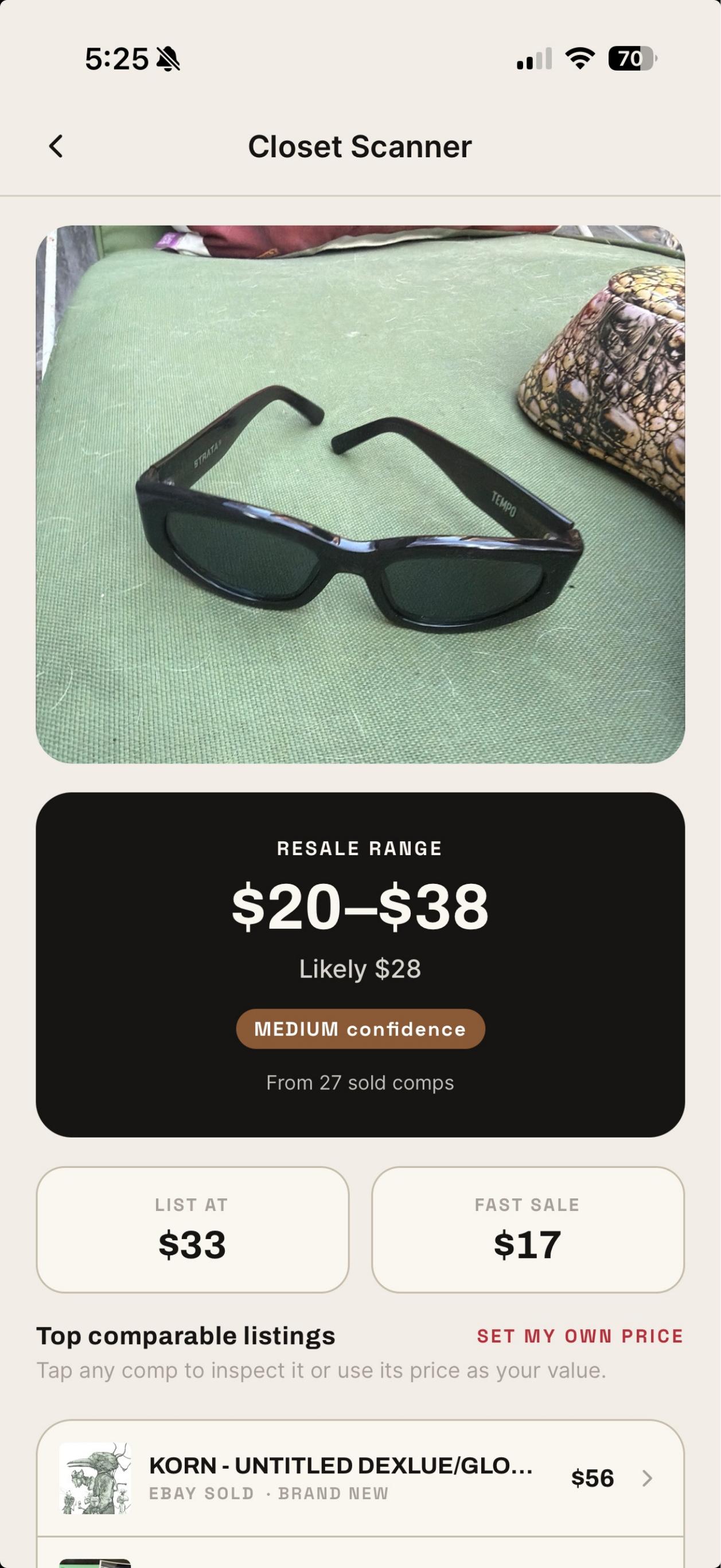
The Closet Scanner identifies brand and returns live resale comps in seconds.
That's one scan. Do it for your entire wardrobe and the app builds a live financial ledger: your total closet worth, updated in real time as markets move. Every piece gets a classification — GRAIL (high value, investment-grade), CORE (everyday workhorse), UNDERPLAYED (high value, rarely worn), or DEADSTOCK (worth selling now).
The Closet Index doesn't just tell you what things are worth. It tells you how you're using them — and the gap between those two numbers is where most people have their first real revelation about their wardrobe.
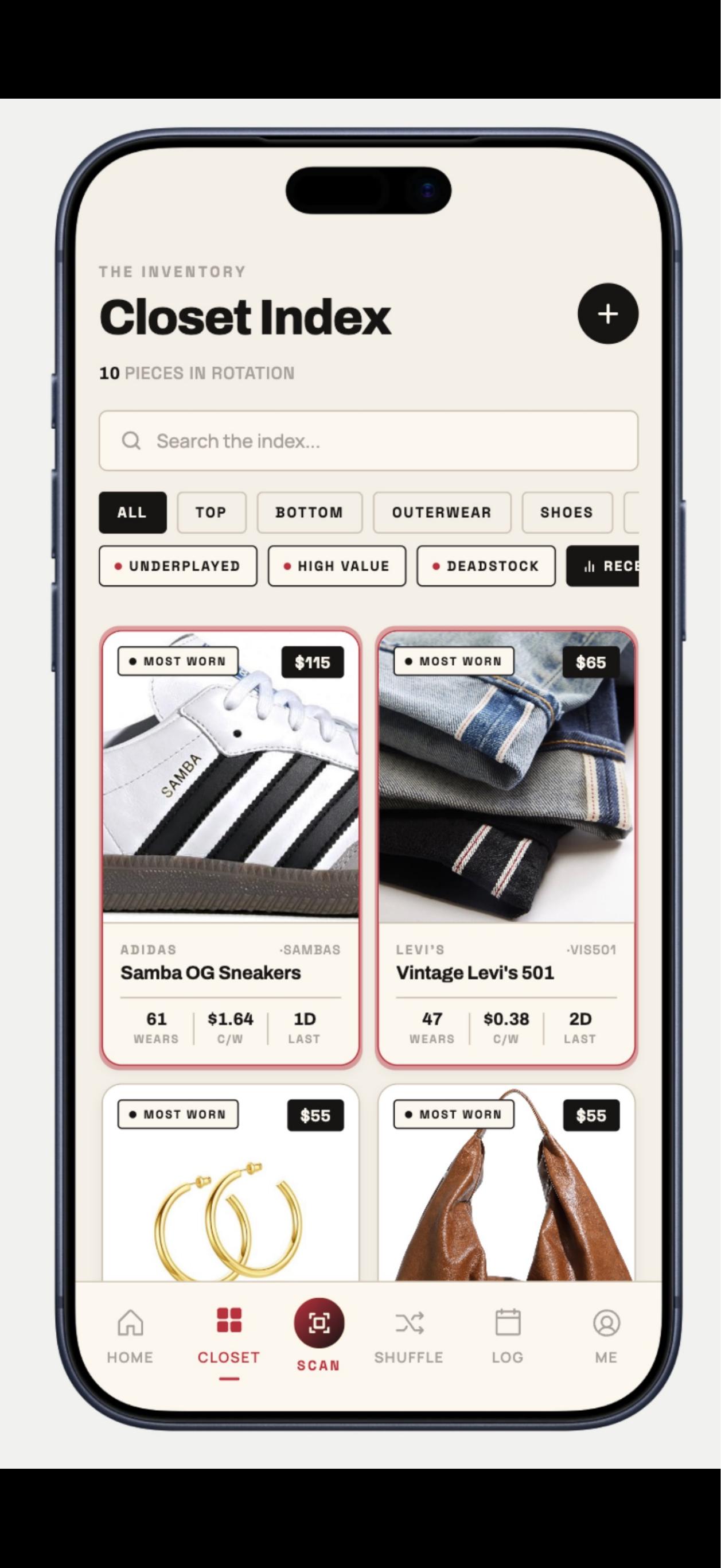
The Closet Index — every piece ranked by value, wear count, and cost-per-wear.
Your Adidas Sambas: worn 61 times, $1.64 per wear. Your Gucci Aces: worn 8 times, $62.50 per wear. Your vintage Helmut Lang jacket, bought at a garage sale for $22: currently worth $680 on the resale market. These are not hypotheticals. These are real numbers from real beta users.
The financial visibility Robely provides does something unexpected: it changes your relationship to shopping. When you can see that you have $4,800 worth of rarely-worn clothing already in your closet, the case for buying something new gets harder to make on impulse. When you can see that your cost-per-wear on a $300 jacket is $3.00 — because you've worn it 100 times — you understand what real value looks like.
This isn't about minimalism. It's about information. And information, it turns out, is the one thing the fashion industry has never given the consumer.
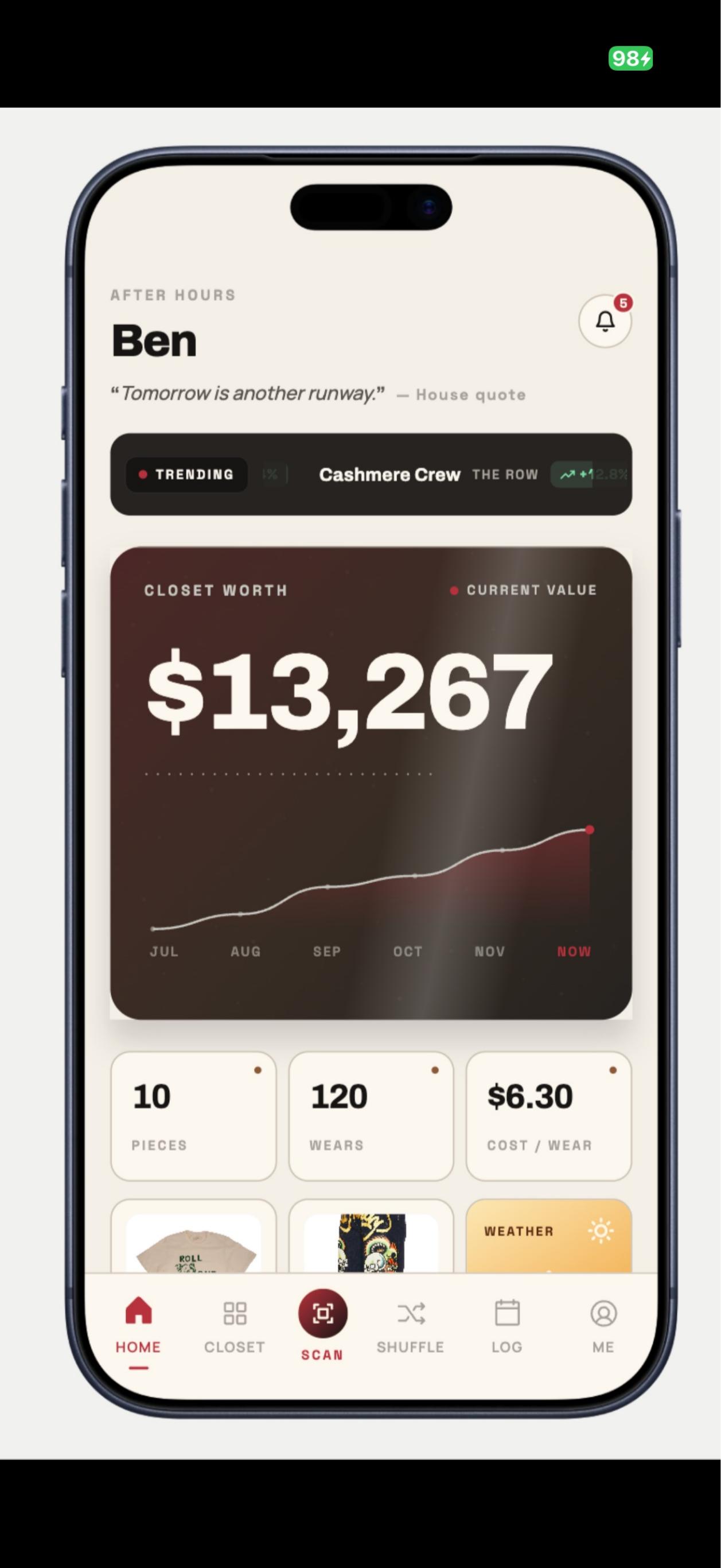
Your closet worth — tracked live, updated as market comps move.
Americans spend approximately $420 billion on clothing per year. The resale market is growing 3× faster than retail. 47% of consumers now consider resale value before buying new. The infrastructure for treating clothing as a financial asset is finally arriving — and Robely is building the consumer-facing layer of it.
Your closet is already worth more than you think. Robely just helps you see it, manage it, and make it work for you.
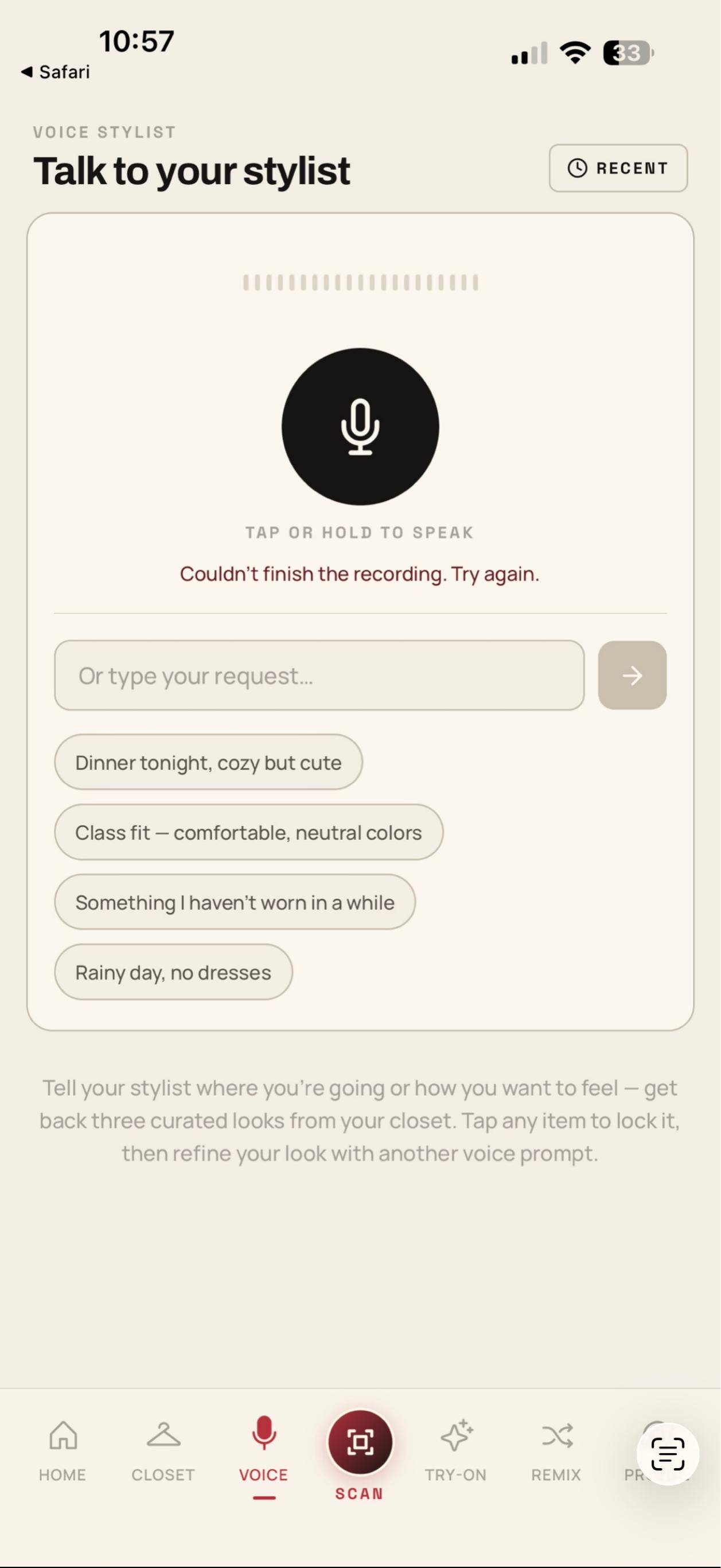
Monday morning. I opened Robely, tapped Voice Stylist, and said six words: "Class fit. Comfortable. Neutral colors."
Within seconds, the app returned three complete outfits built entirely from clothes I already own. Not suggestions to buy anything new. Not a stock-photo mood board pulled from Pinterest. Actual pieces from my actual closet, composed into looks I hadn't thought to put together myself. I wore the first one. Got a compliment by noon.
Voice Stylist — tell it where you're going, get three looks from your own closet.
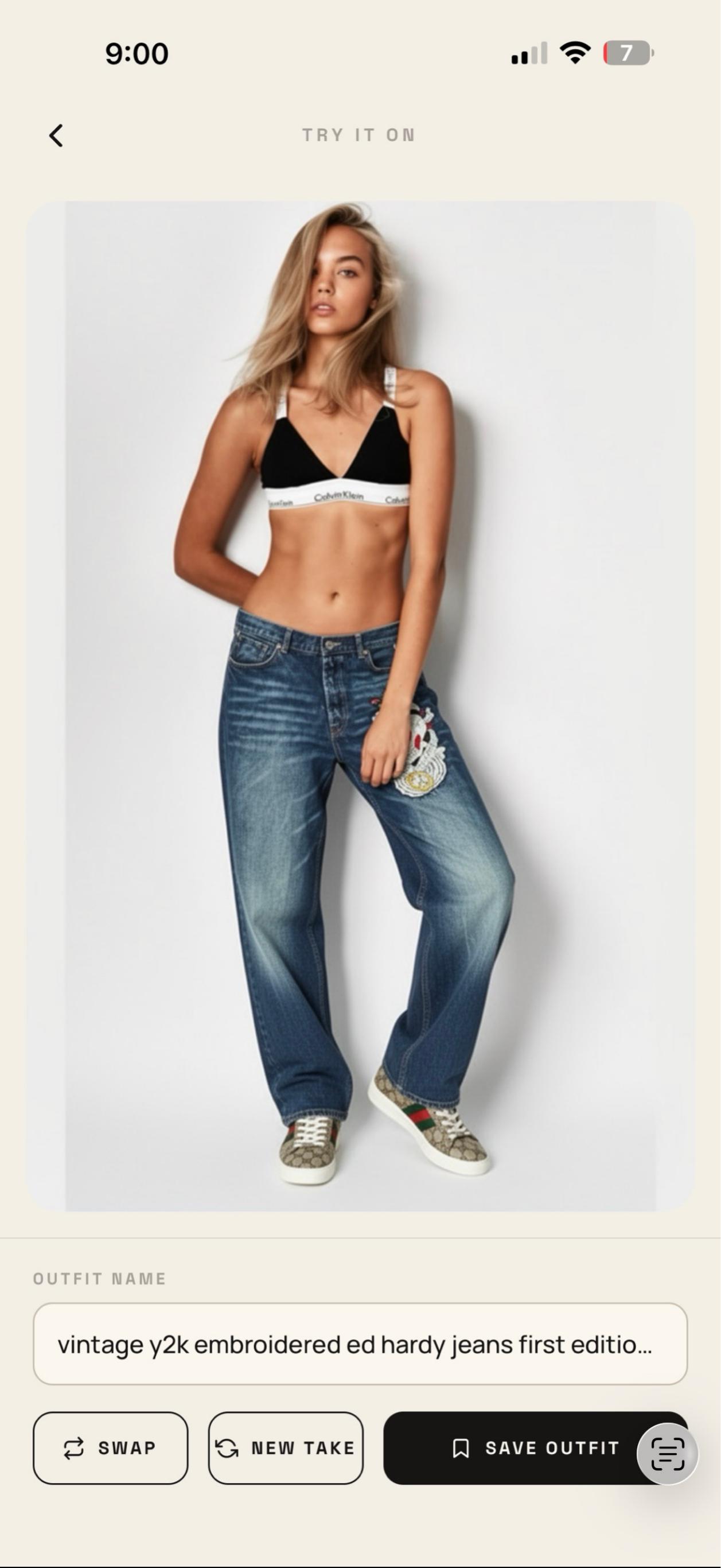
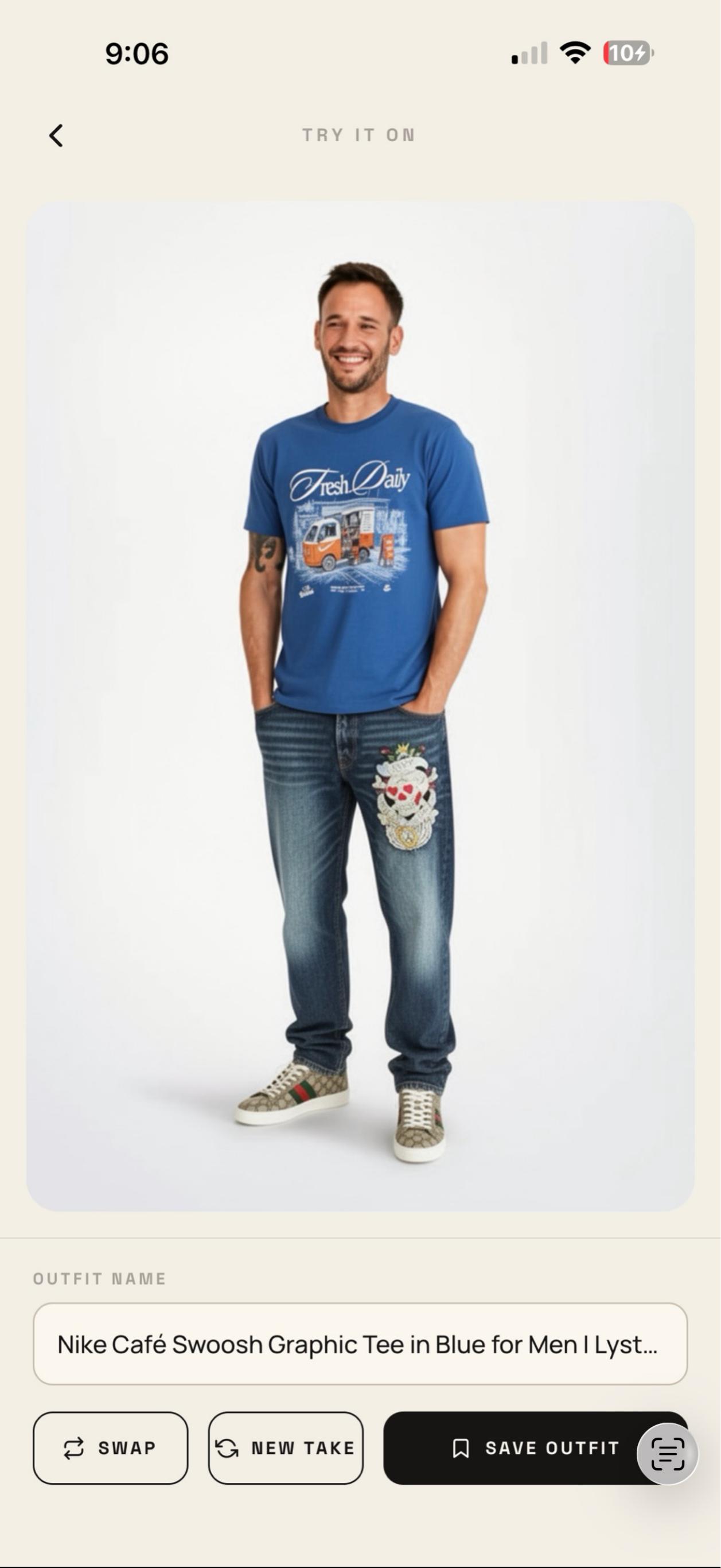
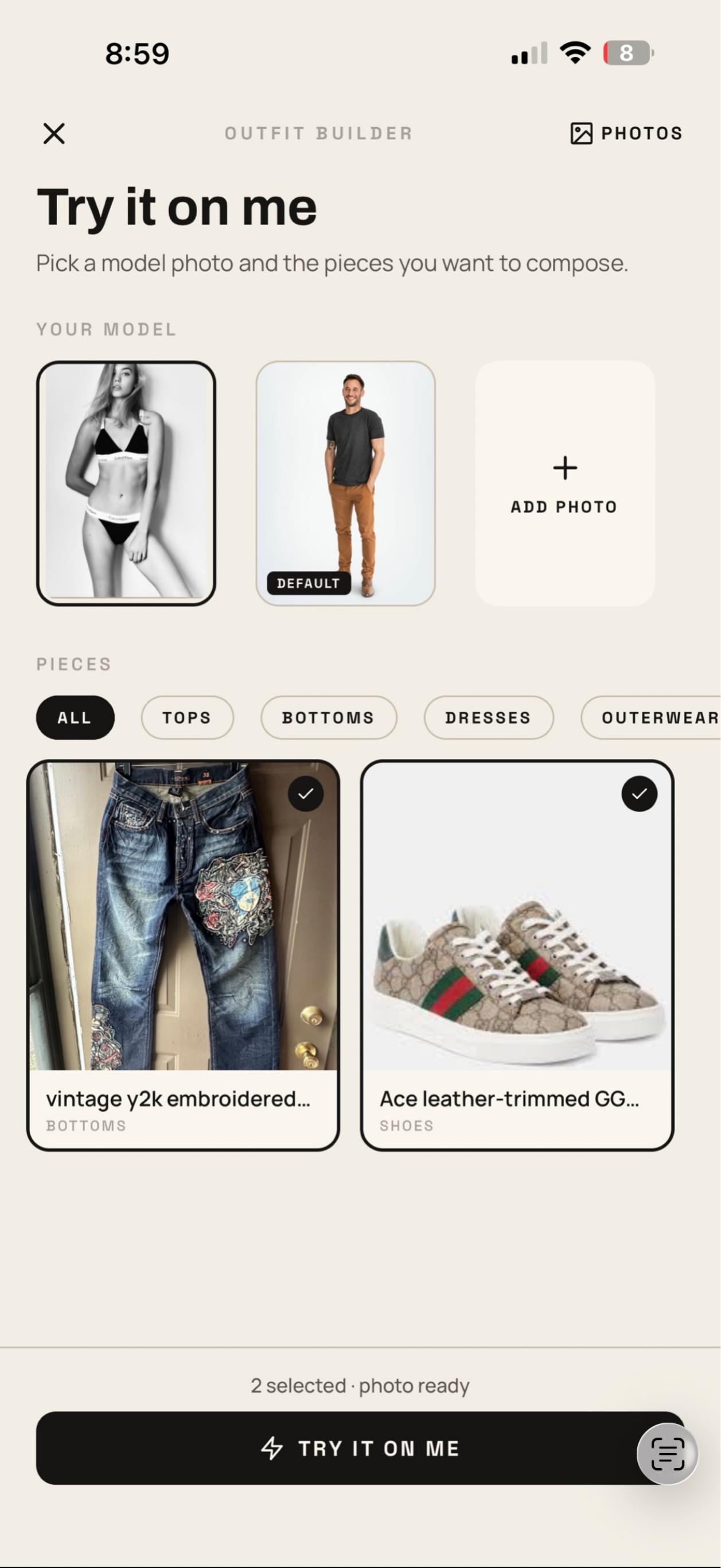
Tuesday, I tried Try-On Me. I selected a vintage Ed Hardy hoodie and my Levi's 501s from my index — two pieces I'd worn separately but never together — picked a default model, and watched the AI place the outfit on a real human body. Not a mannequin. Not a cartoon avatar. A realistic render in about eight seconds.
The result wasn't perfect — the hoodie sat slightly stiff — but I hit SWAP, replaced it with a bomber jacket from my index, and got a new render in another eight seconds. That one looked good. I saved it, wore it Wednesday. Same compliment, different person.
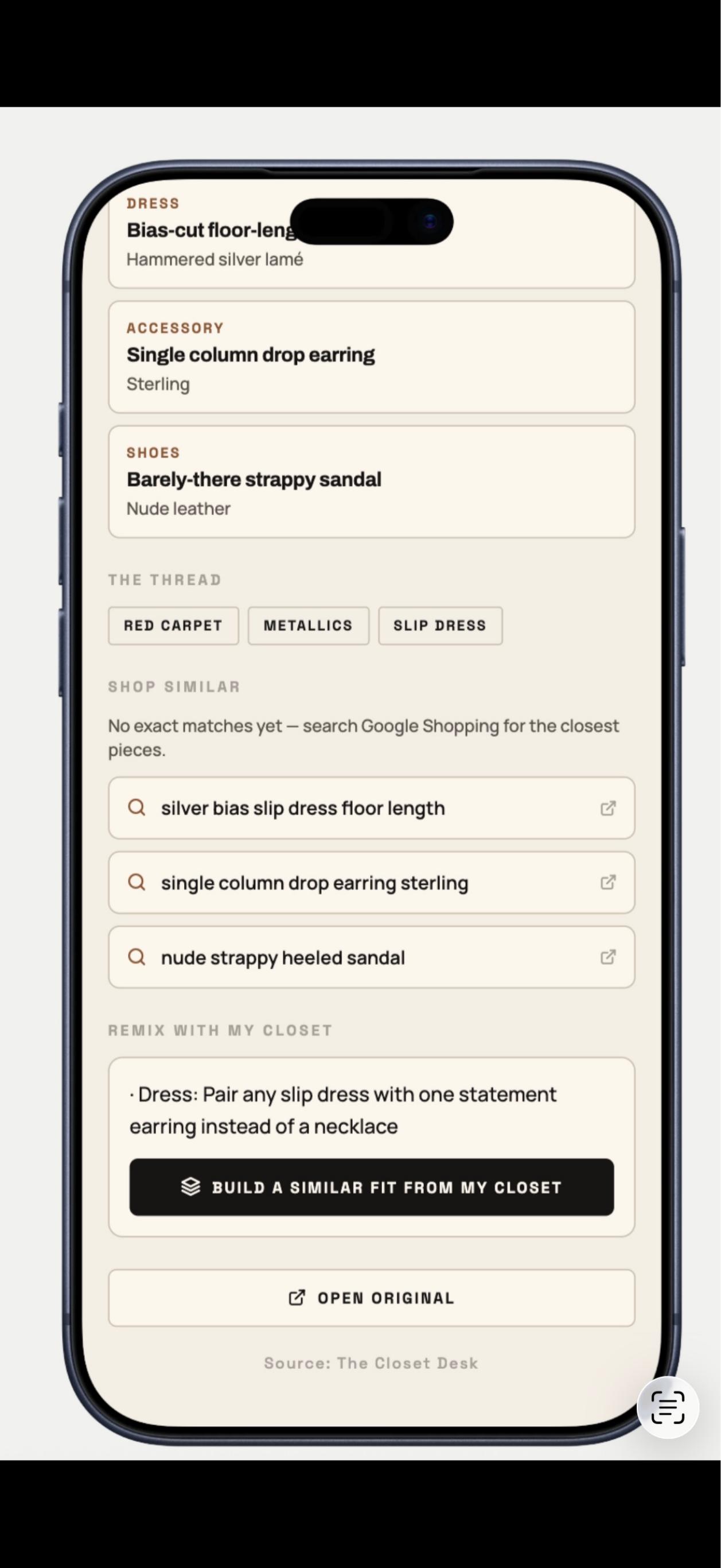
By Thursday I was deep in the Remix feature. The idea is simple but powerful: pick one anchor piece — the item you feel most confident in — and let the app build complete outfit variations around it. I picked my Levi's 501s as the anchor.
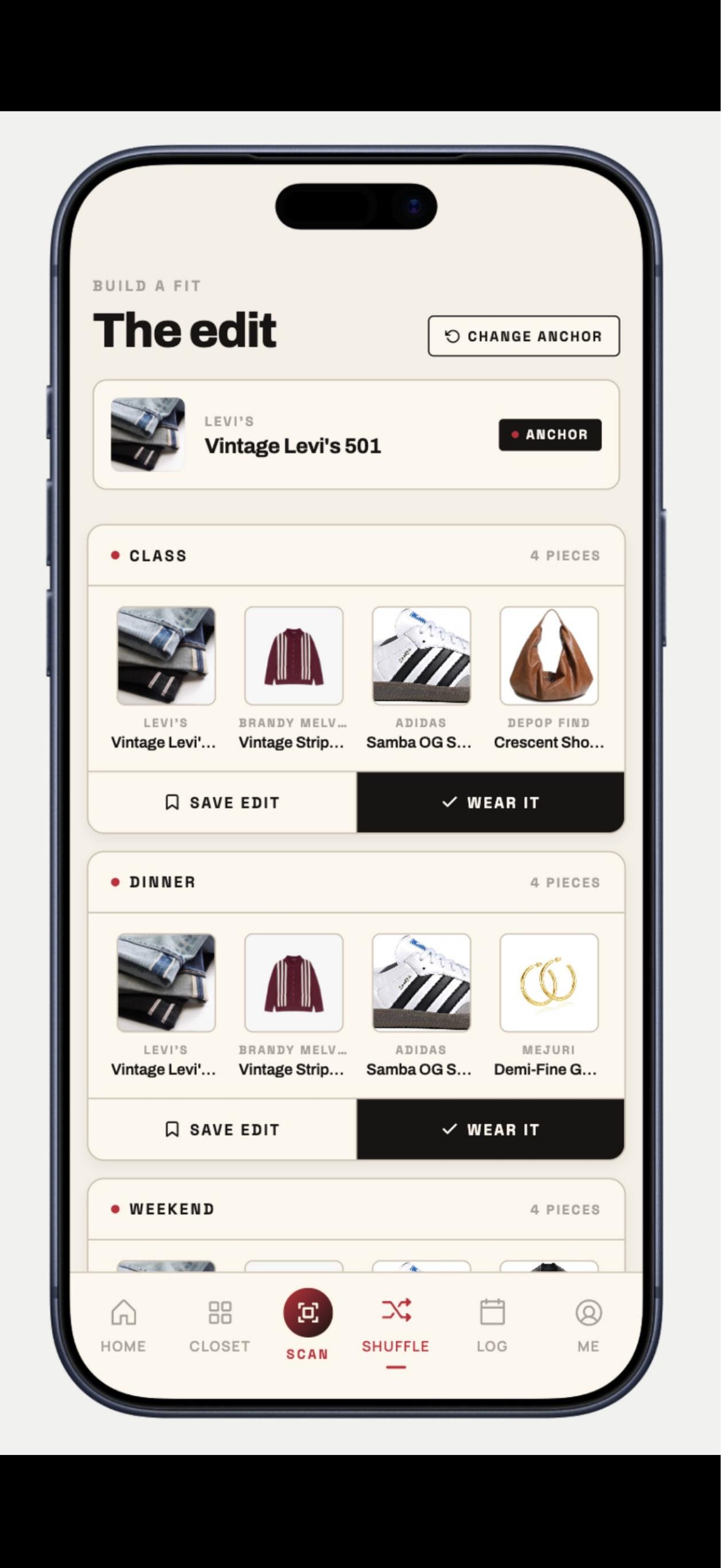
What came back: a CLASS look (Levi's + a Brandy Melville cardigan + Adidas Sambas + Mejuri gold hoops), a DINNER look (same jeans, different top, slightly more elevated), and a WEEKEND option that somehow nailed exactly what I would have put together on my own — except I never would have thought to pair those specific pieces with those specific shoes.
Remix builds CLASS, DINNER, and WEEKEND variations around one anchor piece.
By Friday I'd worn seven distinct outfits from a closet I thought I knew by heart. I hadn't bought a single new thing. I hadn't repeated a look. I'd worn three pieces I hadn't touched in months — one of which, the app noted, was UNDERPLAYED: high resale value, rarely worn, worth either more attention or a listing.
That's what a week with Robely looks like. Not a transformation. Not a wardrobe overhaul. Just the closet you already have, finally introduced to the person who owns it.
Robely, the fashion technology company redefining how people relate to their clothing, today announced the public beta launch of its iOS application — an eight-surface platform that indexes, values, and monetizes personal wardrobes using artificial intelligence.
Unlike wardrobe apps that focus on outfit planning or social sharing, Robely approaches clothing as a financial asset class. The platform's Closet Scanner uses AI vision to identify garments from a photo, match them against live resale data from eBay and Vestiaire Collective, and return a real-time valuation with confidence scoring.
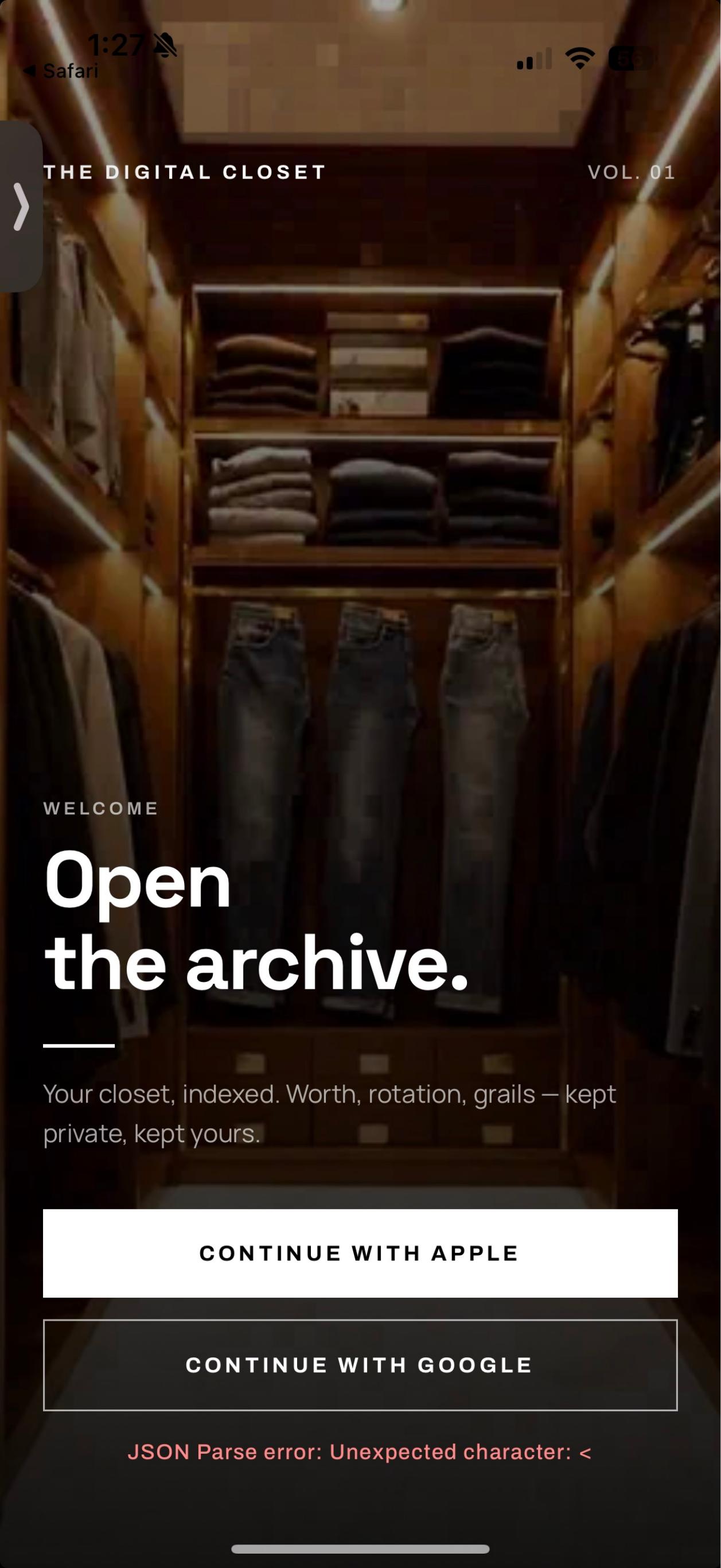
Open the archive — Robely's onboarding welcomes users to the digital closet.
"We asked ourselves: why do people manage their stocks and their savings, but not the $1.7 trillion in clothing sitting in American closets? Robely is the answer to that question. It's Bloomberg Terminal for your wardrobe."
— Robely founding team
The beta launch includes all eight core product surfaces:
Scan — AI vision identifies brand, category, and resale value from a single photograph, pulling live sold comps from eBay and Vestiaire Collective.
Index — Every piece in the closet is graded, classified (GRAIL / CORE / UNDERPLAYED / DEADSTOCK), and tracked for cost-per-wear and days since last worn.
Try-On Me — Users select pieces from their index, upload their own photo or use a default model, and receive a photorealistic outfit visualization in seconds.
Voice Stylist — Natural language prompts return three curated looks from the user's own closet, ranked by occasion fit.
Remix — Users select one anchor piece and receive CLASS, DINNER, and WEEKEND outfit variations built automatically from their existing index.
What They Wore — A daily editorial feed of red carpet, runway, and street style looks, each linkable back to the user's own closet for remixing.
The Closet Index — a financial ledger for every piece you own.
The platform's next surface, the IRL Storefront, will turn every retail receipt into a revenue event. When a friend asks "where did you get that?", the Robely user shows their receipt QR code — the friend scans it, lands on the user's live closet storefront, and purchases the item. The user earns a 2–8% affiliate commission. No new hardware. No influencer status required. No app installation required for the friend.
Robely is available now in TestFlight. Beta access is invite-based and being granted in batches. To request access, visit robely.ai/beta.
Americans collectively own $1.7 trillion in clothing. That number is almost impossible to hold in your head. It's larger than the GDP of most countries. It's more than the combined market capitalization of Nike, Levi's, and Zara. It represents one of the largest concentrations of household wealth in the country.
And virtually none of it is managed.
Think about the financial tools you use on a daily basis. You have a banking app that tracks every dollar in and out, categorizes every transaction, and sends you alerts when you're spending more than usual. You have a brokerage that shows your portfolio in real time — every stock, every ETF, every position with a live price and a performance chart. You probably have a budgeting app. Maybe you track your crypto.
We have unprecedented visibility into our money. But clothing — probably the second-largest category of consumer spending in most people's lives — exists in a kind of financial dark matter. You know roughly what you paid for things, years ago. You don't know what they're worth now. You have no idea how often you actually wear them. And you almost certainly have no sense of what your cost-per-wear is on any individual piece.
The research here is stark. WRAP's 2024 study found that 82% of garments are worn fewer than five times per year. Five times. That means the vast majority of clothing that exists in American closets is not, by any meaningful measure, being used. It's dead capital sitting on a shelf — depreciated but not yet recognized as such, waiting for a donation bag or a garage sale that may never come.
Closet Worth — your wardrobe valued in real time, tracked across months.
Robely gives every piece in your closet a financial identity. Not an estimate. Not a rough guess based on what you paid. A live valuation, pulled from actual sold listings on eBay and Vestiaire Collective, updated as markets move.
The app classifies every piece: GRAIL (high value, investment-grade, worth holding), CORE (your everyday workhorses), UNDERPLAYED (high resale value, rarely worn — the pieces most likely to earn you money), and DEADSTOCK (high value, not worn in months, prime for listing now).
The Closet Scanner returns live resale data — exactly what the market will pay, today.
47% of consumers now say they consider resale value before buying new clothing — up from roughly 20% five years ago. The resale market is growing 3× faster than the broader apparel market. Google searches for "wardrobe as portfolio" grew 340% between 2023 and 2024.
The behavior is already there. The infrastructure for it — the tool that tells you, in real time, what your closet is worth and what to do with it — has been missing. Until now.
Your wardrobe is already worth more than you think. Robely just helps you see it, manage it, and make it work for you.
There's a moment that happens in real life — at a party, on the street, at dinner with friends — that no app, no platform, and no algorithm has ever been able to capture.
Someone looks at what you're wearing and asks: "Where did you get that?"
In that moment, something significant happens. A real purchase intent — genuine, immediate, triggered by a real human recommendation in the real world. Not a paid ad. Not an influencer post. Not a retargeted banner following you around the internet. Word-of-mouth. The oldest, most trusted, and most effective form of commerce ever developed.
Nielsen research shows 74% of clothing recommendations happen in person. And until now, every single one of those moments has been completely invisible to the commerce infrastructure. The brand doesn't know it happened. The person making the recommendation earns nothing. The potential sale — if it happens at all — is entirely disconnected from the conversation that sparked it.
Amazon fixed this problem for influencers. They built storefronts — curated pages of recommended products — that creators could link to in their content. A creator mentions a product, links to their storefront, someone buys it, they earn a commission. It works beautifully, at scale, for people with hundreds of thousands of followers.
But what about everyone else? What about the person at the dinner table whose outfit is generating genuine purchase intent right now, with zero mechanism to capture it?
The IRL Storefront — Robely's next major surface — is the infrastructure that moment has always needed.
Here's how it works. You buy something in-store. The receipt prints with a QR code linked to your Robely profile. When someone asks where you got what you're wearing, you show them the receipt. They scan the QR. They land on your live Robely closet storefront — a page that shows the exact item, with a direct link to where they can buy it. If they purchase, you earn a 2–8% affiliate commission, automatically credited to your account.
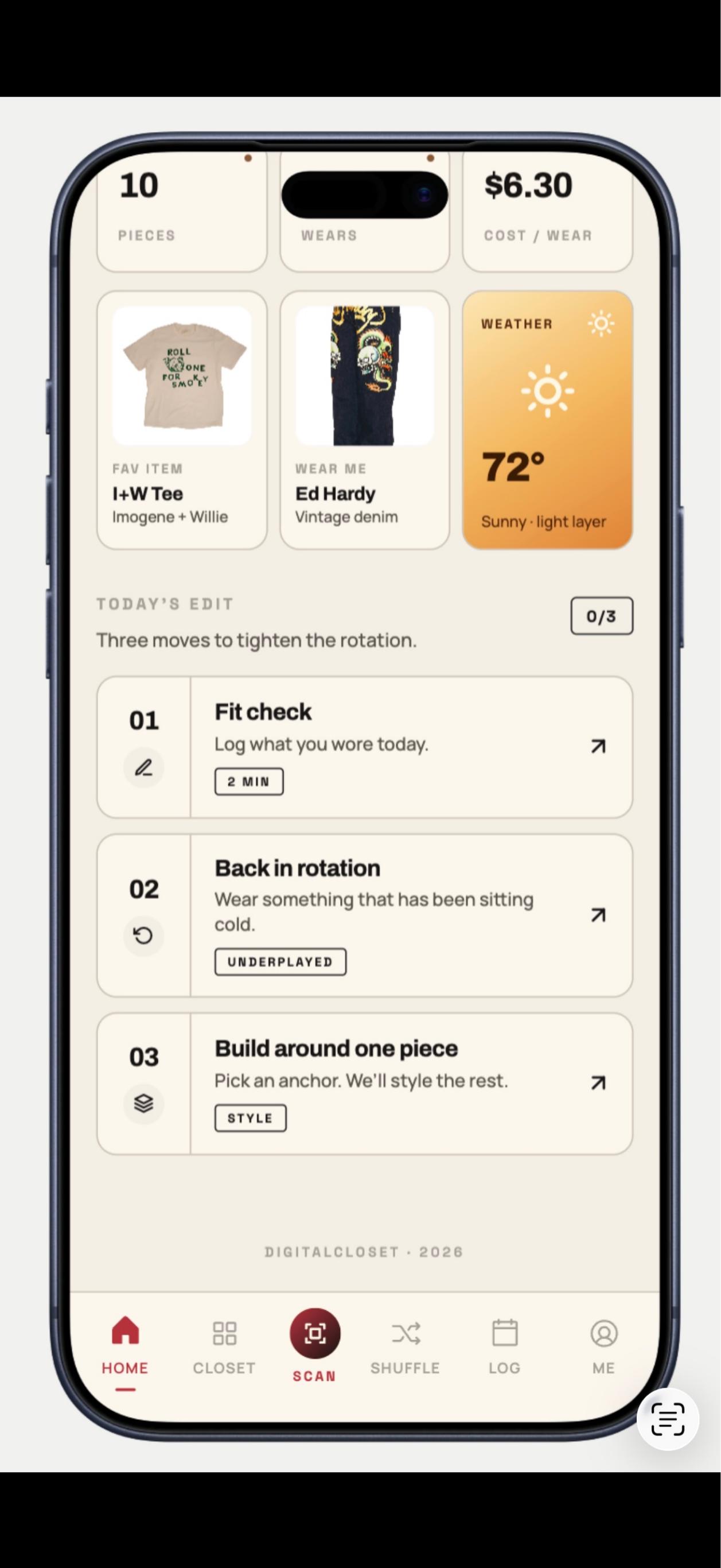
The Robely home screen — your closet, your earnings, your daily edit.
No new hardware. No app installation required for the friend. No influencer status. No content creation. Just a receipt — which you already have — and a closet you've already indexed.
Every Robely user becomes a micro-storefront. Every compliment has a paper trail. Every wear becomes a potential revenue event.
Amazon built influencer storefronts for people with audiences. Robely builds them for everyone — triggered not by content, but by the organic, authentic, high-trust moment of real-world word-of-mouth that already happens billions of times a day and has never, until now, had its infrastructure.
The IRL Storefront does something else that no other feature in the wardrobe space has done: it gives people a financial reason to digitize their closet. Scan your pieces, build your index, and every item becomes a potential affiliate earning. The more complete your closet, the more your storefront can sell. The more your storefront earns, the more motivated you are to keep scanning.
This is the flywheel. And it starts with a question that gets asked a thousand times a day, at dinner tables and coffee shops and street corners everywhere: "Where did you get that?"
Robely today announced that its Try-On Me feature — which composes selected clothing onto a user's own photograph using generative AI — is now live in beta, making Robely the first wardrobe management platform to ship native AI try-on using real user photos rather than stock models, 3D avatars, or placeholder figures.
Users select any combination of pieces from their indexed wardrobe — tops, bottoms, shoes, outerwear, accessories — tap Try-On Me, and choose their model. They can upload their own photograph or use a default model provided by the app. The AI then composes the selected pieces onto the chosen body, producing a photorealistic visualization in approximately eight seconds.
The output is designed to be shared natively — rendered at social-ready resolution, optimized for TikTok and Instagram formats. Users who want to refine their look can use SWAP (replaces a single piece in the current composition without re-selecting everything) or NEW TAKE (generates a fresh interpretation of the same outfit combination).
Try-On Me — a realistic composition using pieces from the user's own closet index.
"Every competitor in this space either uses stock figures or skips try-on entirely. We built Try-On Me because the only body that matters when you're deciding what to wear is your own."
— Robely founding team
The wardrobe app category has been aware of the try-on problem for years. Whering — the largest digital wardrobe app with 9 million users — does not offer try-on at any level. Indyx, positioned as a premium styling platform, relies on human stylists rather than AI visualization. Acloset, dominant in the Asian market, has no try-on feature. Cladwell launched 3D avatar-based try-on in 2024 but does not support user photographs — meaning the model wearing the outfit is never the user.
Robely is the first application in the category to ship photorealistic AI try-on using real user photographs. The feature is live in beta and available to all current TestFlight users.
Beyond the utility of seeing an outfit before wearing it, Try-On Me creates a content flywheel. Beta users report using the feature to plan their week's outfits in one session — visualizing five or six options in under thirty minutes, selecting the best two or three, and entering the week with looks already confirmed. Content creators report using it to pre-visualize and pre-produce outfit content before physically styling the look.
Robely is available now in TestFlight. To request beta access, visit robely.ai/beta.
The capsule wardrobe movement promised simplicity. Own thirty things, they said. Wear everything you own. Live with intention. Curate, don't accumulate. Somewhere in a minimalist apartment with perfect natural lighting, someone with excellent cheekbones is thriving inside their thirty-piece wardrobe and feeling profoundly at peace.
For everyone else — people who love fashion, who thrill at a vintage find, who have a formal wardrobe and a weekend wardrobe and a gym drawer that refuses to stay organized — the capsule ideal is mostly aspirational guilt dressed up as philosophy.
The problem the capsule wardrobe was trying to solve is real: most people feel overwhelmed by their closet, wear a fraction of what they own, and spend money on things they don't need because they can't clearly see what they already have.
The capsule solution — own less — addresses the symptom, not the cause. The cause is invisibility. The cause is that most closets are opaque: full of objects that exist in a kind of permanent present tense, with no history, no value data, and no connection to each other.
Remix builds full outfit variations from what you already own — no new purchases required.
Robely is not a capsule wardrobe app. It doesn't tell you to own less. It doesn't send you prompts to declutter or suggest that the right number of shoes is twelve. It doesn't have a shame mechanism.
Instead, Robely starts from where you actually are: a closet full of things you love, things you've forgotten about, things you bought for a specific occasion and haven't touched since, things that are worth more today than you paid for them. It indexes all of it. Tags it. Prices it. Tracks it. And then it works with what you have to show you the closet you didn't know you already owned.
Today's Edit — three concrete actions every morning to help you actually use your closet.
Every morning, Robely's home screen shows you Today's Edit: three concrete actions based on your index. Log what you wore yesterday (two minutes). Wear something that's been sitting cold — a piece you haven't touched in 30+ days that the app surfaces for you. Build around one piece — pick an anchor and let Remix generate the rest.
These aren't productivity hacks. They're the operating manual for a closet that works. Not a smaller closet. Not a curated capsule. Your closet, finally understood.
The future of getting dressed isn't thirty pieces of perfectly curated merino. It's the 140 pieces you already have, indexed, valued, and finally introduced to each other — and to you.
I used to think I was a pretty conscious shopper. I waited for sales. I read reviews before buying. I told myself I only bought things I really loved. I had a rough sense of what I spent on clothing per year — somewhere around "a lot" — and I'd mostly made peace with that.
Then I scanned my closet.
The first thing Robely showed me was my cost-per-wear breakdown. Not what things cost at purchase — what they actually cost, divided by how many times I'd worn them.
My Adidas Sambas: 61 wears, $1.64 per wear. One of the best purchases I've made in five years. My Gucci Ace sneakers: 8 wears, $62.50 per wear. Dead capital in a beautiful box. My Omega Speedmaster, which I'd scanned mostly out of curiosity: currently worth $4,200 more than I paid for it three years ago.
The Closet Scanner — real market data on what your pieces are worth today.
Three numbers. Three completely different stories about objects I owned and thought I understood. The Sambas are perfect. The Aces need to either be worn or listed. The Speedmaster is an investment I made accidentally and should probably pay more attention to.
Here's what changes when you have this information: the calculus of buying shifts. Not dramatically, not overnight, but measurably. When you know that a $300 purchase worn 100 times costs $3.00 per wear, and a $90 purchase worn 3 times costs $30.00 per wear, your brain starts doing the math automatically. The question stops being "do I love this?" and starts being "will I actually wear this?"
Those are different questions. And they lead to different decisions.
Every piece, graded — wear count, cost-per-wear, days since last worn, resale value.
The classification that hit hardest wasn't GRAIL or DEADSTOCK. It was UNDERPLAYED: pieces with high resale value that I wasn't wearing. When Robely flagged my Gucci Aces as UNDERPLAYED, it wasn't judgment — it was data. Those shoes are worth $620 on the current market. Every day they sit in a box, I'm either holding a depreciating asset or failing to wear something I spent money to own.
I started wearing the Aces more. Within a month, cost-per-wear dropped from $62.50 to $38. Still not great. But moving in the right direction — and I'm finally enjoying the thing I bought.
Less. Not nothing — I still love shopping, and Robely hasn't cured me of that. But the purchases I've made since starting to use the app are different. More deliberate. More focused on versatility and wearability rather than just aesthetic appeal at the moment of purchase. I ask myself: how many times will I actually wear this? Where will I wear it? What's it going to pair with in my existing index?
Those questions were always the right ones. Robely just made them unavoidable.
As the U.S. secondhand clothing market accelerates toward $73 billion by 2027 — growing 3× faster than retail apparel — Robely is emerging as the foundational infrastructure layer connecting personal wardrobes to the resale economy.
The resale market has two well-funded endpoints: the consumer marketplace (The RealReal, ThredUp, Depop, Poshmark) and the brand-side circular economy infrastructure (Eon Exchange, Archive, Trove). What has been missing is the consumer-facing intelligence layer — the tool that sits at the very beginning of the resale funnel, inside the closet, before any item is listed or shipped.
Robely fills that gap. The platform's Closet Scanner indexes wardrobe pieces with live resale valuations, classifying each item by market status and wear history. The upcoming Sell Signal feature will notify users when market comps for specific items spike, providing a recommended listing price, pre-filled item description, and direct integration with eBay and Vestiaire Collective.
Closet Worth — your wardrobe valued live, with trending pieces surfaced automatically.
"The RealReal and ThredUp are great at selling. Robely is great at knowing. We're the layer that tells you what to sell, when to sell it, and what it's worth — before it ever leaves your closet."
— Robely founding team
47% of consumers now say they consider resale value before buying new clothing — up from approximately 20% five years ago. The behavioral shift toward treating clothing as a financial asset is well underway. The $73 billion in projected U.S. resale volume represents consumer demand that is growing faster than any marketplace's ability to capture it.
Robely's thesis is that the constraint on resale growth is not demand — it's friction. People don't know what their clothes are worth. They don't know when to sell. They don't have a tool that makes the decision easy and the listing process seamless. Robely removes all three barriers.
The platform's IRL Storefront feature — in development — will create an additional resale-adjacent revenue stream that requires no active listing by the user. When a friend asks about an item and purchases it via the Robely storefront QR, the brand fulfills the order directly. The user earns a 2–8% commission without ever shipping a package or managing a listing. This positions Robely's affiliate mechanic as a zero-friction entry point to the resale economy for users who find traditional consignment too cumbersome.
eBay and Vestiaire Collective integrations are planned for the next product sprint. Robely is available now in TestFlight at robely.ai/beta.
Walk through the fashion technology landscape and you'll notice something that becomes harder to unsee once you spot it: almost all of it is built for brands.
AI recommendation engines? Their primary value proposition is to the retailer — driving higher average order value, reducing return rates, increasing purchase frequency. Virtual try-on at the point of sale? Built to reduce the operational cost of returns for brands, with the consumer benefit as the justification. Digital product IDs embedded in garments? Primarily so brands can track their products through the secondhand market and capture data on the resale lifecycle — data they use to inform future pricing and design decisions.
The person who actually owns the clothes — who wears them, who paid for them, who makes daily decisions about them, who has real financial stake in what they're worth — is, in most of the fashion tech stack, primarily a data source and a target. A conversion event to optimize. A behavior to predict and influence.
This isn't malice. It's incentive structure. Brands have large marketing budgets and clear ROI requirements. Consumers don't. Building for brands is easier, faster to monetize, and more legible to investors. So that's what gets built.
What They Wore — editorial inspiration linked directly back to your own closet.
Robely was built from the opposite direction entirely. Every feature in the platform was designed to give the user more. More visibility into what they own. More capability to style and use it. More financial intelligence about its value. More earning potential from assets that are already in their possession.
The Closet Scanner gives consumers the market intelligence that brands have always had and consumers have never had — live resale valuations, comparable sold listings, real-time price movement. The IRL Storefront gives consumers an affiliate earning mechanism that brands reserve for influencers with massive followings. The Voice Stylist and Remix features replace the function of a professional stylist — a service that has historically been available only to people who can afford to pay for it.
The Robely home — your closet's performance dashboard, built entirely for you.
Robely is not anti-brand. Far from it. Brands benefit enormously when consumers develop a more sophisticated, financially literate relationship with their clothing. A Robely user who scans their Gucci Aces and discovers they've held their value isn't going to sell them — they're going to wear them more, and probably buy another pair with more confidence. A user who understands cost-per-wear is a better customer for quality brands than one who only responds to sales.
The IRL Storefront is a net positive for brands — turning every piece of their clothing into a continuously active affiliate marketing channel driven by authentic word-of-mouth, with zero media spend required.
Consumer trust in advertising is at historic lows. Authenticity has become the primary currency of influence. The resale market — built on individual recommendation and personal curation — is growing 3× faster than retail. The consumer is increasingly sophisticated, increasingly skeptical, and increasingly interested in owning their relationship with their clothing rather than being marketed at through it.
Robely builds for that consumer. Not as a data point. As a person with a closet, a budget, an aesthetic, and real financial stake in the assets they already own.